

7. Conclusions

Just talking? How relationships disrupt social disadvantage

At the beginning we set ourselves a series of questions. Given what we know now, what are the answers?
First, why would relationships make a difference? There isn’t much in our evidence to suggest that workers fix anything. Mental health problems may or may not improve. If they do get better, there isn’t much in this dataset that can be used to trace change back to a therapy or treatment approach. If there is a practical problem like homelessness or lack of money or a job, no agency has easy remedies.
When things get better it is because the person being helped considers the time is right to change. They take responsibility for that change. They are able to think straight about the options. And they have a sense that the future can be improved, which at very least demands a feeling of mattering to others in this world. It looks as if the workers, simply by relating in straightforward ways, consistently, and over relatively long periods of time produce a series of effects in those they help such as better management of emotions, reflection anew about life’s options, and taking responsibility for their future.
Second, what are the attributes of workers who appear to be good at relating? When we write down their characteristics, much as the human resources department constructs a job description, the workers come across as wonderful people, optimistic, emotionally mature, passionate and tenacious. Unlike the HR department, there isn’t much in our account about qualifications, training, or courses attended. It is their personal qualities that seem to matter.
The trouble is these virtues do not add up to a satisfactory explanation. It seems reasonable to suggest that many people with these qualities are not proficient at relating to people facing lots of challenge in life. And, although we did not get to it in this study, it would be surprising if the good relators were not difficult in some ways, hard to supervise, for example, idiosyncratic maybe. Our answers to this question remain limited. There are missing elements to data and the analysis.
In a neat and ordered world the boxed findings would be transformative.
What are the features of organisations that value relationships? Here we feel on safer ground. Trust is placed in the relationship. Great effort is invested in finding the workers who can relate to those seeking help. (The worker is put before the programme or therapy). Workers earn the trust of the helped, which pays a dividend in terms of the organisation’s trust in the worker. Organisations that value relationships are patient and tolerate idiosyncrasies in helpers and helped. But they are not anarchic. The best can articulate a practice model that expresses, in broad terms, what workers are meant to do and why. These models are a platform for workers to excel, not a constraint.
The following box summarises the main findings.
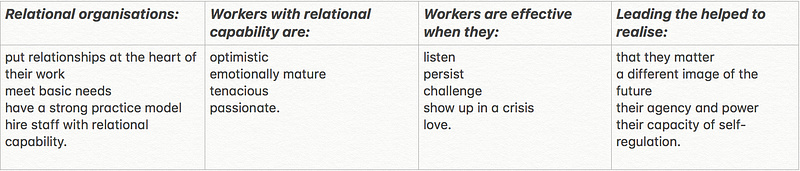
In a neat and ordered world the boxed findings would be transformative. We have identified a list of factors common to organisations that foster good relationships with the people they are set up to help. We know something about the characteristics of the effective workers. We have picked out aspects of relationships most valued by service users. And we have suggested reasons why the relating could have the potential to transform the lives of the most challenged in our society. It is almost a formula, ready for application.
Except our world is not neat and ordered, and the world examined in this study is especially unstable. Linear equations don’t work in these contexts.
There are other reasons to mistrust what we have found. We only looked at organisations that espouse the value of relationships. It is not outside of the bounds of possibility that organisations that never think about relationships nonetheless forge connections with those they support as strong if not stronger than those in our network. In all likelihood we would learn more about good relating from organisations and workers who consistently fail at the task. And as deep as we dug in this qualitative study, we probably only captured a few of the behaviours that comprise an effective relationship.
We have hypotheses. Nothing more. We have lifted the lid on a world that has remained largely undisturbed in the last three decades and found reason to explore more.
Nonetheless, even on this limited evidence, we feel there may be important implications for policy, practice and innovation. Here we suggest a few points to how we think about this in a U.K. context. (Full report will also contain recommendations from the U.S. version of this work.)
Things that get in the way: It would not be unreasonable to read the report as a description of practice from another era. It certainly stands against the grain of social policy in the last 30 to 40 years with its emphasis on classification, measurement, accountability for specified outcomes, often all tied together in a contract on which the provider organisation depends for survival.
A drive for efficiency can limit opportunities to listen. Tenacious workers don’t care much for targets. Narrow outcomes seldom extend to mattering. A focus on risk will never make space for love. In the course of the research we have seen practice models from members of the PCN squeezed into logic models required by philanthropic funders, abandoning any mention of relationships along the way. Passion is routinely sucked out of workers by the hoover of a standard public sector commissioning framework.
Digging Deeper: As previously indicated, we see these findings as the beginning not the end of a new understanding about how to improve human health and development. This study, for example, underpins others looking at the amount of variance in outcomes that can be explained by, on the one hand, an intervention -for example giving someone a place to live or exposing someone to a therapeutic technique that helps them re-frame a problem- and, on the other hand, a relationship -the quality of connection between helper and helped. The data set used for this study has been further mined to understand the mechanism by which relationships trigger change, including the way different forms of empathy disrupts patterns of thinking in the helped. Others around the world are following analogous leads.
Things We Don’t Know: Inevitably, in addition to discovery, research reminds us of the things we don’t understand. In what contexts are relationships irrelevant? At a crude level we can say that a person having a tooth cavity filled probably doesn’t need a strong bond with her dentist.
What role does training play, if any. Not all the workers interviewed in the study were qualified, and those who were had a variety of professional backgrounds. All valued training. But while relational capability can be enhanced by instruction it seems unlikely it can be taught. In the sense that professional status can distract, we can also see how training might undermine relational capability.
Then there are the minutiae. Those aspects of the interaction like tone of voice, bearing, eye movement and contact. Could machine learning techniques help in pick out patterns that may evade the human eye?
Difficult Conversations: There is much in the evidence that is uncomfortable, difficult to write and harder to discuss. In the context of half a century of policy and practice guidance on professional boundaries between teachers and pupils, clinicians and their patients, it seems almost naive to suggest a conversation about love. Yet it is clear that many skilled practitioners are operating to high ethical standards that elicit a sense of love between them and the people they help.
The trust invested by the state in people paid to help others is no less challenging. In some contexts, local authority social work for children and families for example, practitioner engagement is prescribed, limited and closely recorded. Yet many of the NGO employed (and state funded) workers studied for this paper are given almost a free hand to manage their time and relationships with service users. Trust between helper and helped is fundamental. Is it time for the state to better trust those it pays to help.
Workers worry about other things. They can see, for example, how trauma troubles those they help. They are drawn, for this reason, to training that explains how trauma leads to certain behaviours. But there isn’t much, in the short-term at least, to reduce the trauma. So what to do with the training?
Want to keep up with the R Word? Subscribe to our mailing list here. Learn more about how this conversation started here.